Puerto Villamil at Isla Isabela Highlights
- Enjoy outstanding snorkeling in the Galápagos marine sanctuary
- Visit one of the most pristine, unspoiled National Parks in the world
- Experience wildlife and scenery like you never have before
- Get up close and personal with the fearless animals
- Take a cruise to the best islands with at least two different stops per day
- Go island hopping to four main towns with daily excursions to nearby sites
Overview
The Galápagos Islands are a distinct group of volcanic islands comprising 18 main islands, 3 smaller islands, and 107 islets. They're located on the equator off the west coast of South America, 973 km (605 mi) from mainland Ecuador, and spread over 220 km (137 mi). Due to the distance between islands, the best way to visit the islands is with a cruise of varying lengths from 5-8-15 days. Endless highlights make this unparalleled universe a must-have on your bucket list. In addition to the above water places to visit, the Galápagos are also a great destination for scuba diving.
#1 Devil's Crown (Isla Floreana)

Snorkeling aficionados will be delighted by this volcanic crater, an underwater paradise, which is home to an array of fascinating marine species such as Tiger Snake Eels, White-tipped and Hammerhead sharks, Eagle Rays, sea turtles, and sea lions.
#2 Isla Bartolomé

Climb the moonlike terrain to experience one of the most picturesque views of the Galápagos. The beach to the south is the nesting site for green turtles, whereas to the north, you can see penguins near Pinnacle Rock.
#3 Punta Moreno (Isla Isabela)

These lava-covered visitor points sometimes go under the radar, but upon closer exploration, a whole new world of ducks, flamingoes, and more come to life. Great blue herons and flightless cormorants are also frequently found. Trekking along this pahoehoe lava makes for an exciting adventure.
#4 Elizabeth Bay (Isla Isabela)

This cove provides arguably the finest kayaking in Galápagos. As bigger ships are not allowed, you can kayak through the Bay, meeting penguins, marine iguanas, and be stunned by the exceptionally large mangrove trees.
#5 Urbina Bay (Isla Isabela)

Located at the foot of Isabela's volcano, you'll find all kinds of interesting artifacts, from coral to marine skeletons, as well as some of the biggest marine iguanas in all the islands.
Chat with a local specialist who can help organize your trip.
#6 Punta Espinosa (Isla Fernandina)

Bright-red Sally lightfoot crabs scatter over the lava outcrops, which are also home to the endemic lava cactus. You'll marvel at the playful sea lions, whales, and dolphins, and, at low tide, spotted eagle rays and turtles. Also, one of the top snorkeling spots on the islands, and perhaps one of the most beautiful places to visit on the islands.
#7 Punta Vicente Roca (Isla Isabela)

This visitor site is a wet landing for snorkeling; here you can swim through underwater caves and see the primitive bullhead shark, as well as all other kinds of one-of-a-kind marine species.
#8 Buccaneer's Cove (Isla Santiago)

A panga ride to this area, where pirates once sought food, can provide encounters with boobies, sea lions, fur seals, and other marine birds, as well as the opportunity for snorkeling.
#9 Darwin Bay (Isla Genovesa)

Bird Lovers will delight at this island where most of Galápagos most iconic birds can be found, from different colored boobies to sharp-beak ground finches, and Great Frigate Birds, as well as beautiful views.
#10 Post Office Bay (Isla Floreana)

An intriguing spot for tourists, historically used by whaling boat sailors who traveled for long periods to send letters to their families. Sailors homeward bound would pick up the letters from Post Office Bay and deliver them for the whalers, who wouldn't return home until they had filled barrels of whale oil. At Post Office Bay, visitors can sort through thousands of postcards from tourists from around the world or leave your business card for fun.
#11 Rábida Island

On this Mars-like island, you'll have yet another out-of-this-world experience, with excellent bird-watching, featuring some of the rarest bird species on the archipelago, as well as a beautiful red landscape that is due to high iron content and is also covered in Palo Santo trees and prickly pear cacti.
#12 Cerro Dragon (Isla Santa Cruz)

A panga ride around the shore will reveal land iguanas, green turtles, sharks and rays, and various migratory birds. Along the 3km (2mi) trail, you'll travel through dry vegetation to a small hill, which is home to the exotic land iguanas. Don't miss the lagoons full of flamingoes as well.
#13 Charles Darwin Station (Isla Santa Cruz)

At Charles Darwin Station, you'll see science at work; wander through various trails to discover the Giant Tortoise Breeding Center, once home to Lonesome George before his passing in 2012. A fascinating project is also underway to bring the Pinto species of giant tortoises back from extinction.
#14 Plaza Sur Island

This small islet off the eastern coast of Santa Cruz is home to a large sea lion colony, diverse bird species as well as Nazca and blue-footed boobies, iguanas, and cactus trees. If you're lucky to be traveling to Plaza Sur Island from May to December, you'll have the pleasure of seeing the island change to a red color thanks to the Galapagos carpet weed, an endemic succulent that is very prevalent on this islet.
#15 Isla Santa Fe

Just south of Isla Santa Cruz is where you may find incredible species such as the endemic Santa Fe Land Iguana, as well as lava lizards, Galápagos Hawk, and an array of birds and sea life that will astound.
#16 Gardner Bay (Isla Española)
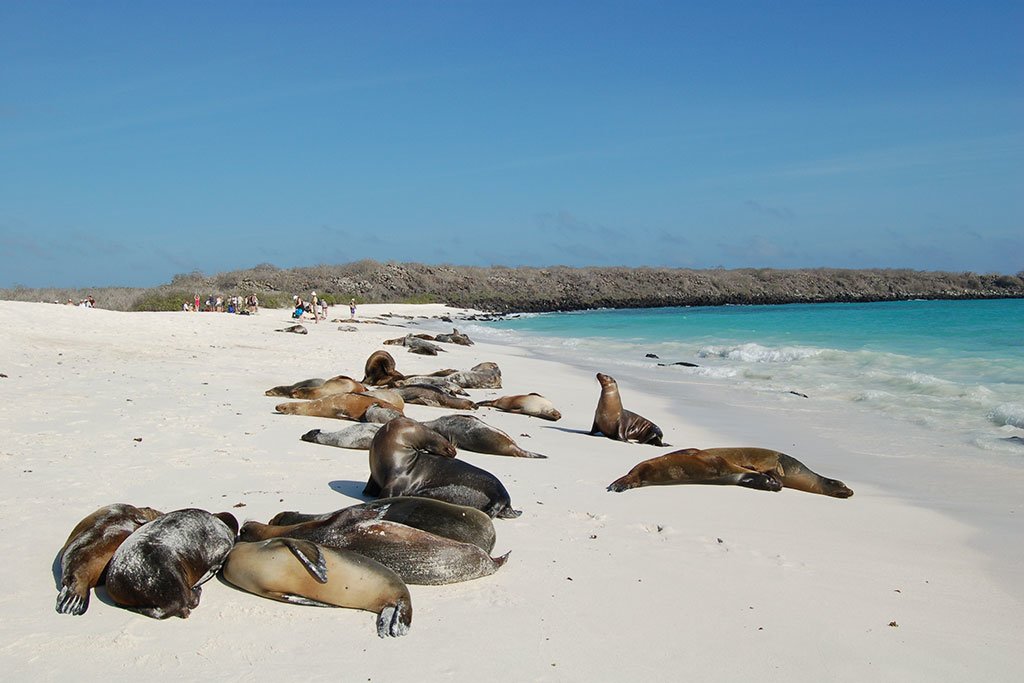
At Gardner Bay, you'll find a pristine white sandy beach with turquoise waters, one of the longest in all of the Galápagos Islands. Here, sea lions lounge, and the Española mockingbird scurries to greet you. Isla Tortuga and the Gardner Islet, you can snorkel and see all kinds of different sea life.
#17 Punta Suarez (Isla Española)

As any bird lover will tell you, Española is where the waved albatross can be spotted from April to December, as well as the Española mockingbird and the Española lava lizards. You can also see three species of Darwin's finches, different species of boobies, oystercatchers, and land marine iguanas, including the red males who change color during the breeding season. A geyser spraying water 25m (75 ft) in the air makes Punta Suarez, without a doubt, one of the most popular landing sites in the Galápagos.
When to Go
The Galápagos Islands are a year-round destination with a pleasant climate, no matter what time of year you choose to go. Average temperatures range from 22°C- 25°C (72°F-77°F).
Getting There & Away
Baltra Airport is the main jumping-off point for most Galápagos tours. Here, surrounded by salt brush and Palo Santo trees, is where your amazing journey will begin. Once you clear immigration, you'll be transported by bus to the cruise ship or the hotel, which will serve as your base for your island-hopping tour.